
INAMI · TOYAMA · JAPAN
INAMI WOODCARVING
More than 250 years, carved by hand.
INAMI · TOYAMA · JAPAN
More than 250 years, carved by hand.
THE ORIGIN

Inami woodcarving traces its origins to Zuisen-ji, a Jōdo Shinshū Buddhist temple that has long stood at the center of the town's religious and architectural life and is renowned for its intricate decorative carving.
Zuisen-ji was established in Inami in 1390. In 1762, the temple was destroyed by fire. During its reconstruction, skilled craftsmen were brought from Kyoto, including the sculptor Maekawa Sanshirō.
Sanshirō taught advanced carving techniques to local temple carpenters. Those techniques were passed through workshops and master–apprentice relationships, forming the foundation of the woodcarving tradition that developed in Inami.

A dragon attributed to Sanshirō from this period remains at Zuisen-ji today.
As temple and shrine commissions continued, workshops multiplied throughout the town. Apprentices trained under established masters, later becoming independent craftsmen and training apprentices of their own.
Over successive generations, Inami developed from a community of temple carpenters into a concentrated center of professional woodcarving.

RANMA
Ranma are carved transom panels installed above partitions between rooms in traditional Japanese architecture.
In openwork examples, carved openings allow light and air to pass between spaces while transforming the panel into a sculptural architectural element.

Their origins lay in temples and shrines, where ranma were typically large, substantial, and designed for monumental architectural settings.
Those forms were poorly suited to the smaller proportions of private homes.

Inami master carver Ōshima Goun reimagined ranma for domestic interiors, developing works that were more elegant, delicate, and visually light.
Greater use of open space allowed the carvings to sit naturally within the more intimate scale of the home.
Among Goun's disciples was the first-generation Nambu Hakuun. He was one of several craftsmen of that era who carried this new direction forward, developing ranma with a refined use of negative space and helping establish a new generation of domestic carving in Inami.
In modern terms, it was a form of product development: traditional carving knowledge adapted to a new architectural context.
The result helped spark a boom in ranma for private homes.


Inami craftsmen became particularly accomplished in ranma, carving landscapes, plants, animals, architecture, mythology, and scenes from nature.
The technical demands are considerable.
A ranma may extend several meters while remaining only a few centimeters thick. Foreground, middle distance, and background must be established within that limited depth, while every element must project and recede without weakening the structure of the work.
The composition must also respond to architecture: the scale of the room, the direction of light, and the position from which it will be viewed.
As demand expanded, residential commissions provided regular work for workshops and supported the training of new apprentices.
By the postwar period, more than 300 artisans were active in Inami, making the town Japan's largest center of woodcarving.
To understand what sustained that growth — and what would later be placed at risk — it is necessary to look more closely at the craft itself.
THE CRAFT
Inami was never defined by ranma alone.
Its craftsmen have applied their skills across architectural carving, decorative panels, sculpture, temple and shrine work, restoration, furniture, private commissions, and works conceived as artistic expression.
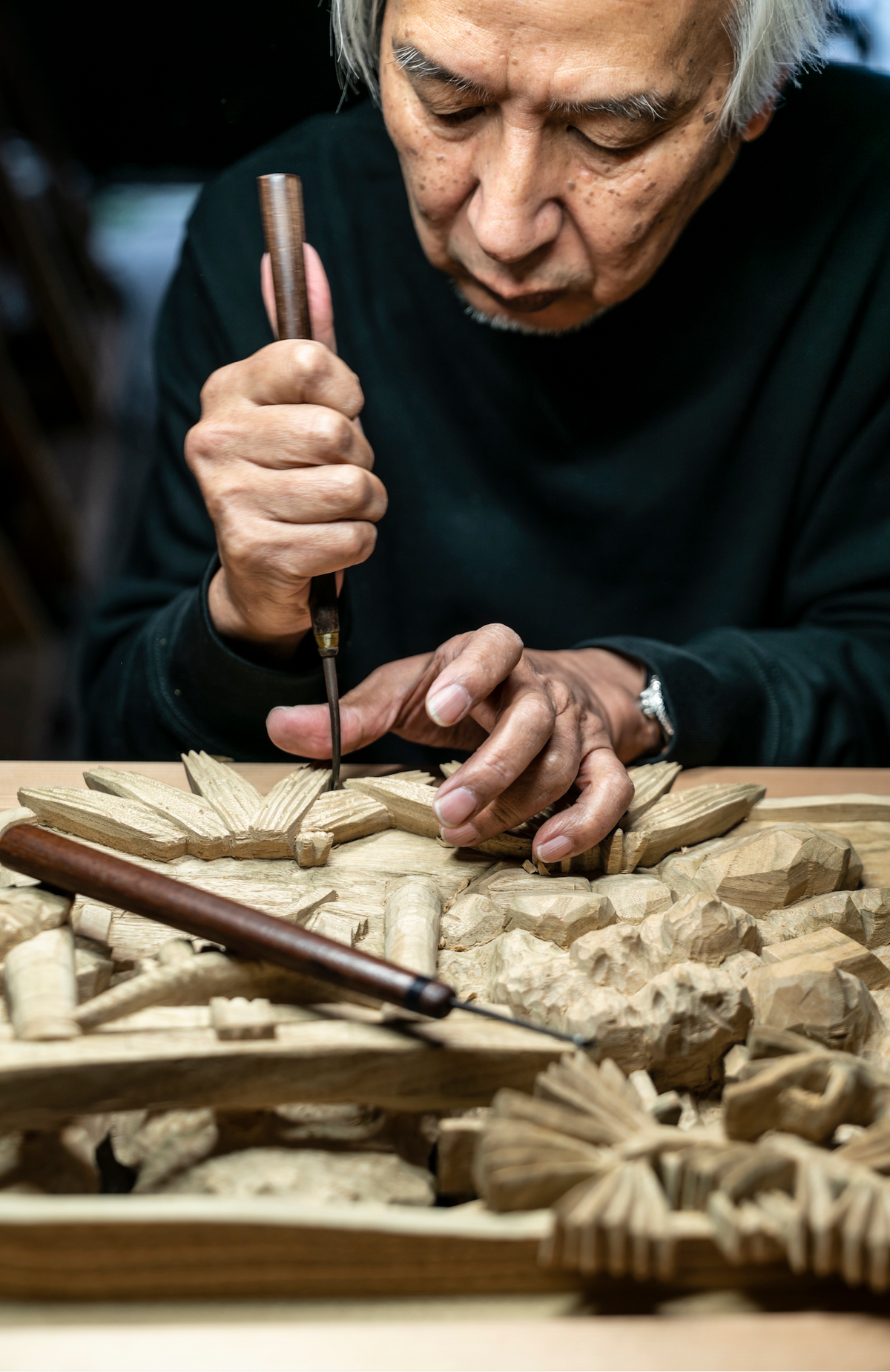
What unites them is the act of subtraction: form is created by removing material from solid timber.
A commissioned work often begins with conversation and a preparatory drawing.
The craftsman translates the intended subject, scale, and setting into a plan for three-dimensional form — deciding what will project forward, what will recede, and where enough wood must remain to support the composition.
Once the timber is selected, carving proceeds gradually.
Rough carving establishes the principal volumes; intermediate carving develops depth and structure; increasingly fine chisels resolve the details and surface.
Because the process is subtractive, every stage requires foresight.
Material removed cannot be returned.
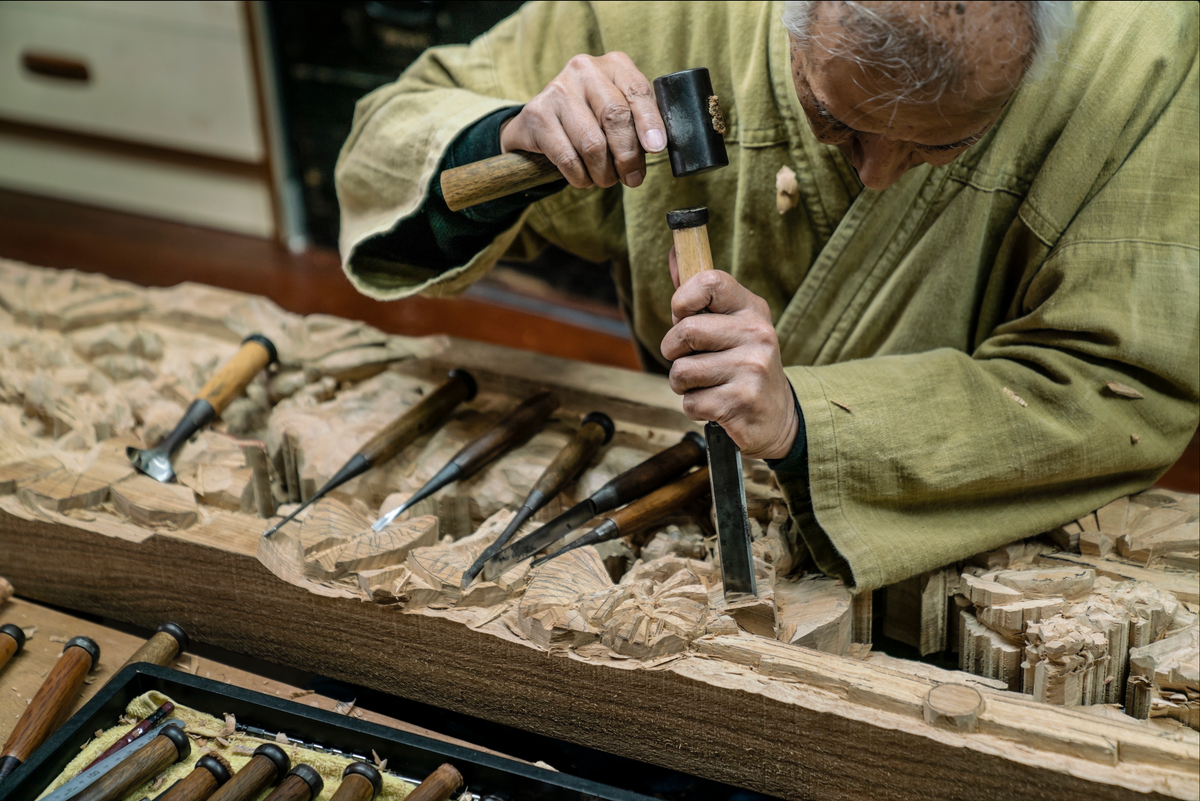
ROUGH CARVING
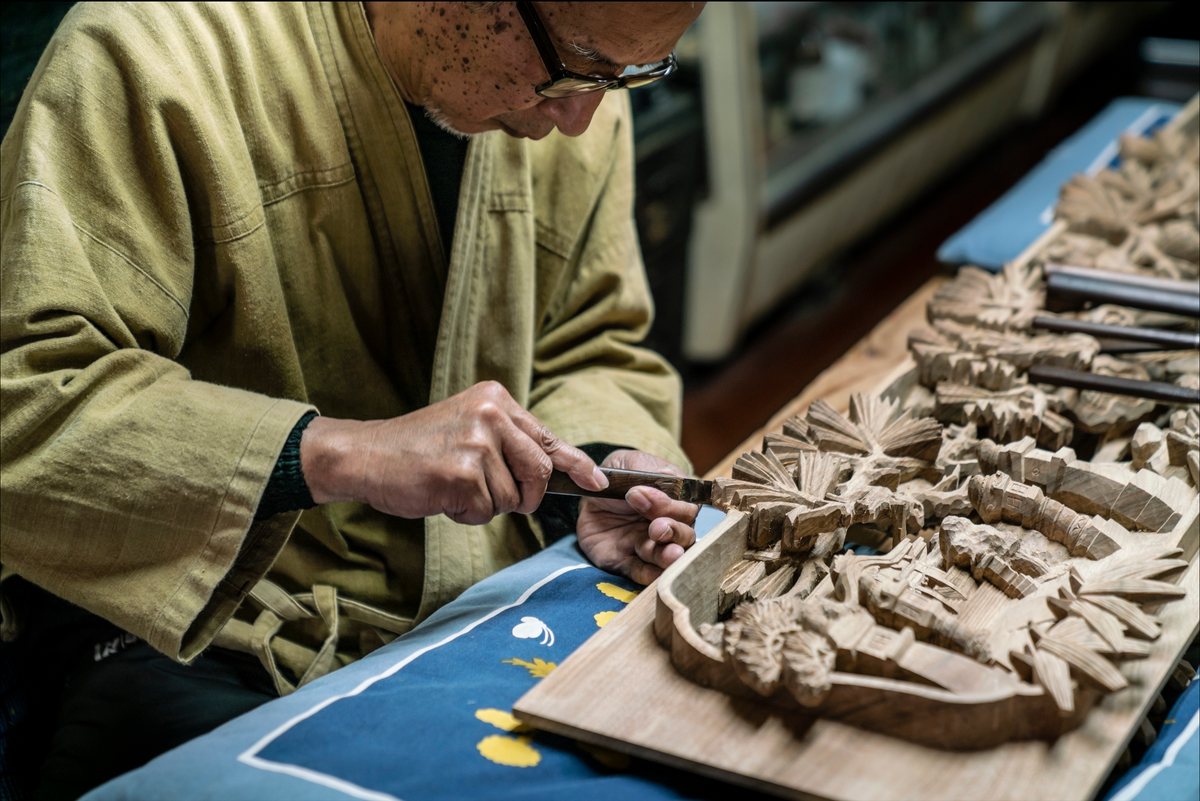
FORM & DEPTH
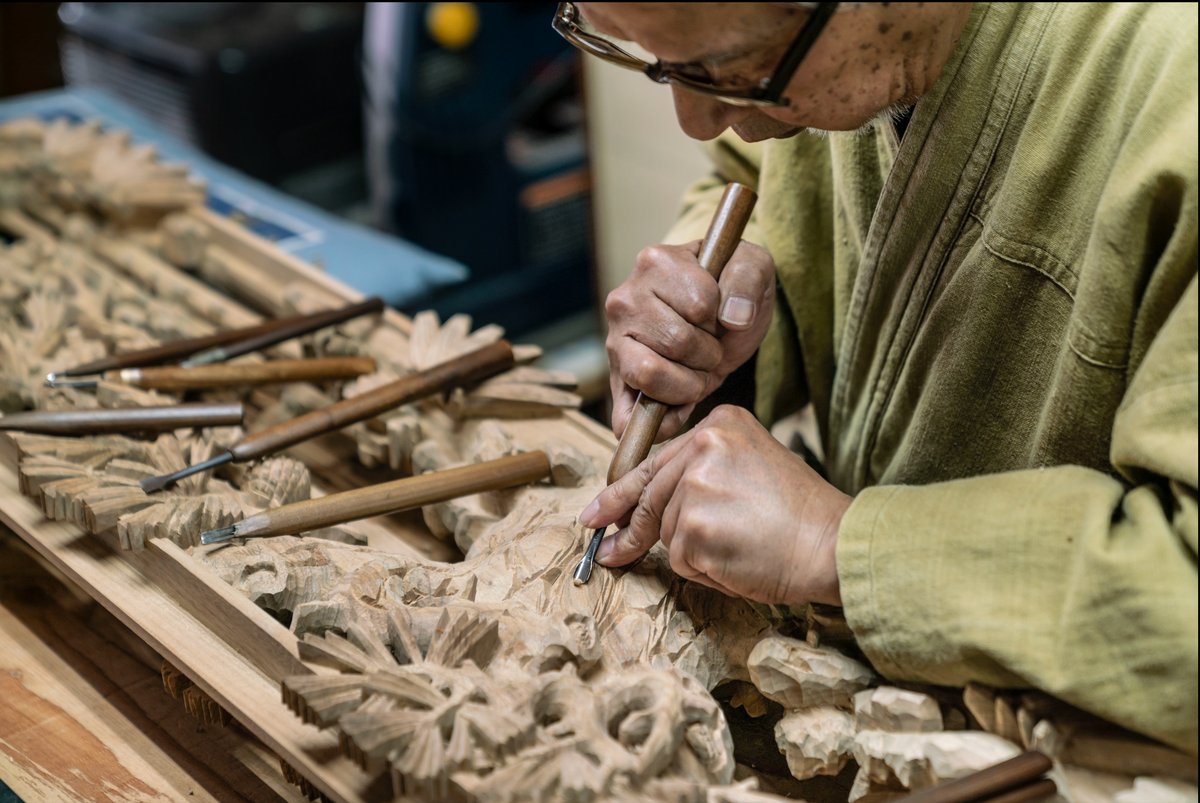
DETAIL & FINISH
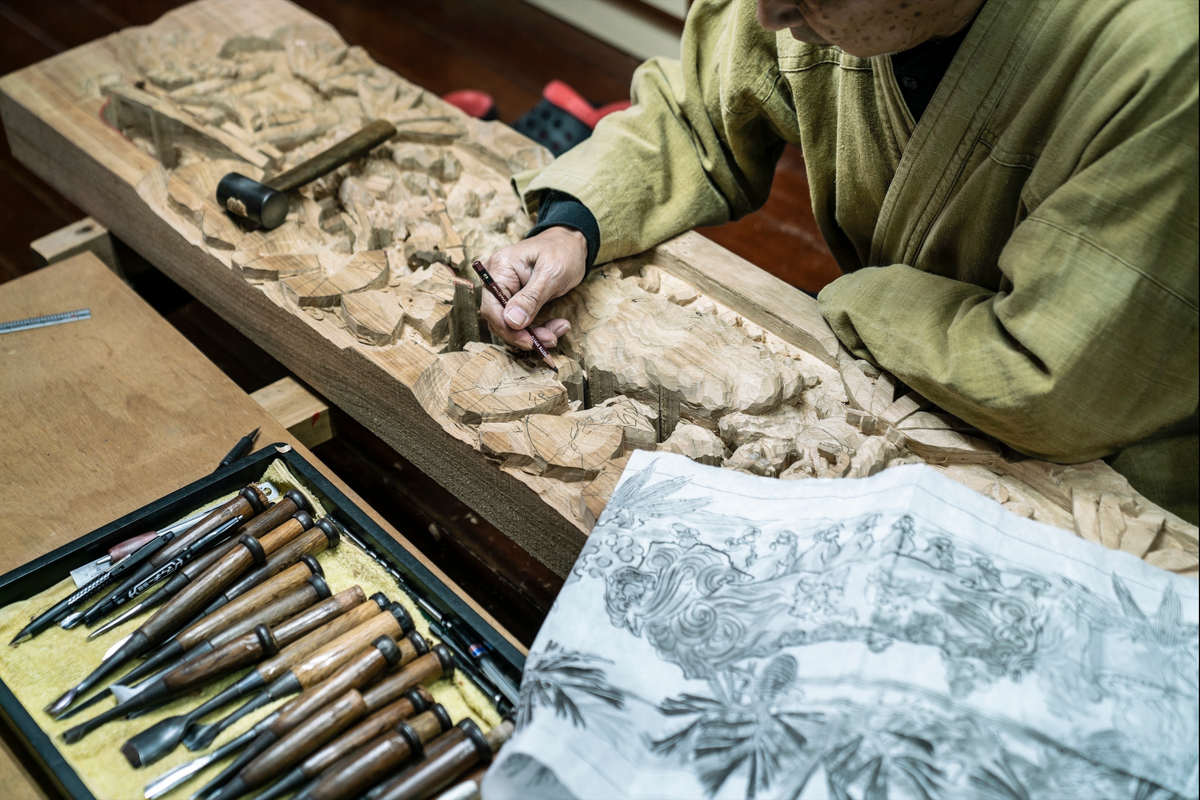
Traditional finishing is carried out with chisels rather than sandpaper.
An experienced craftsman may work with more than two hundred chisels of different widths, profiles, and functions, sharpening and maintaining each by hand.
Deep carving creates spatial depth.
Openwork can remove portions of the background entirely, allowing forms at different levels to overlap and turning a relatively shallow piece of timber into a complex sculptural space.
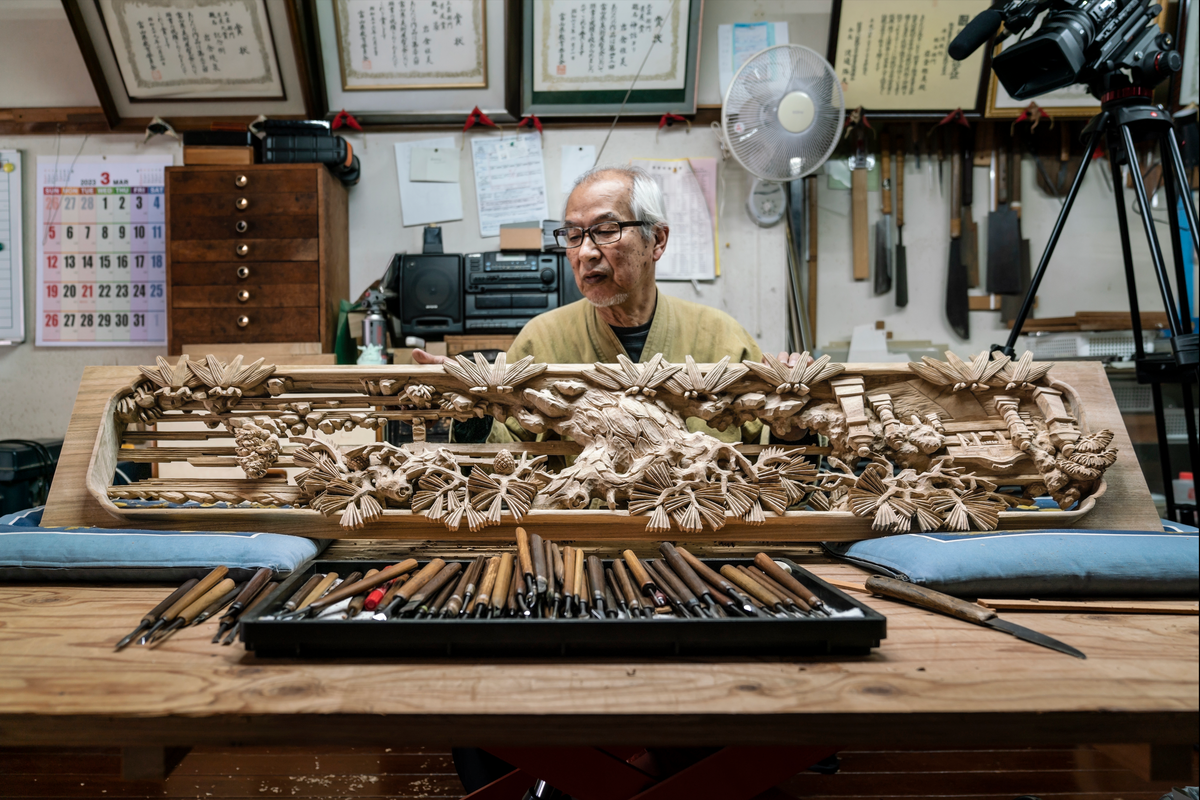
The finished work carries the memory of every considered cut: a form shaped not by what was added, but by what was carefully released.
APPRENTICESHIP
At the heart of Inami's craftsmanship is its rigorous master–apprentice system.
Traditionally, becoming an Inami woodcarver requires a minimum five-year apprenticeship under an established master.

The craft is not taught through written instruction.
It is absorbed through immersion in the workshop: watching the master and senior apprentices work, learning how they hold the tool, read the grain, sharpen a chisel, judge depth, and respond when the wood behaves unexpectedly.
Training begins with the fundamentals of workshop life and gradually progresses toward increasingly demanding carving.
Through years of observation, repetition, trial, and failure, the craft becomes embodied.

Five years is only the foundation.
Once independent, a craftsman's pursuit of mastery does not end.
New commissions present unfamiliar problems. More difficult work demands greater judgment. Earlier masters are studied, techniques are tested, mistakes are made, and skill continues to deepen across an entire working life.
The apprenticeship system remains active today, and each apprentice becomes another link in a chain of knowledge extending back through generations.
Mastery in Inami is never truly finished.
For generations, this system was sustained by a steady flow of demanding work.
Then the conditions that supported it began to change.
A GLOBAL SHIFT
The conditions that sustained Inami through much of the twentieth century began to change dramatically.

As Western-style housing and standardized construction became increasingly common in Japan, traditional Japanese rooms and many of the architectural features that accompanied them became less central to domestic life.
Modernist movements in architecture and design favored functionalism, standardization, and the rejection of ornament.
Ranma became increasingly uncommon in new homes, and demand fell sharply.
But the shift was broader than ranma alone.
Industrialization, mechanized production, and global supply chains made standardized objects faster and cheaper to produce, weakening the place highly skilled decorative craftsmanship once occupied in everyday life.
A master cannot train the next generation in theory.
Apprenticeship depends on real work: real materials, real mistakes, real commissions, and years spent learning through practice.
While industrialization and mass production caused many decorative-art traditions to disappear, Inami persisted.
At the heart of that resilience is the spirit of the shokunin: craftsmen committed to refining their skills and evolving the craft.
As demand changed, Inami's craftsmen carried techniques rooted in sacred architecture into ranma, sculpture, restoration, furniture, decorative works, contemporary architecture, and new forms of commission.
But adaptation alone cannot secure the future.
Many of Inami's most experienced craftsmen are growing older. Relatively few young people are entering the demanding apprenticeship system, and current domestic demand is not enough to sustain the same depth of training for another generation.
The question is whether there will be enough meaningful work for the next generation to continue carving.

BEYOND JAPAN
During the Meiji period, Inami craftsmen participated in exhibitions and international expositions.
Yet while Japanese art forms such as ukiyo-e traveled widely and influenced artists around the world, Inami remained comparatively unknown abroad — likely in part because monumental architectural carvings were far more difficult to transport and exhibit than small, portable works such as woodblock prints.
For most of its modern history, the tradition therefore developed principally through domestic commissions.

More than a century later, that is beginning to change.
In 2025, Poiesis and master woodcarver Nambu Hakuun III brought Inami woodcarving across the United States through live carving demonstrations, lectures, documentary screenings, displays of works, and public programs.
Audiences could encounter not only finished carvings, but the tradition behind them: the tools, apprenticeship, judgment, and time involved in their creation.
The programs brought Inami into universities, museums, cultural institutions, and public spaces across the United States.
The journey also helped create something more permanent.
Seven historic ranma by master carver Soun Taniguchi, created in 1981 for the Kenken Ochin restaurant in Kanazawa, are being given a new life at the Morikami Museum and Japanese Gardens in Florida.
Preserved together with preparatory drawings and documentation, the works can continue to be encountered and studied long after the architecture for which they were created has disappeared.
For Inami, however, international recognition is not the destination.
The deeper objective is continuity through new relationships and new work.
Poiesis works alongside the Inami woodcarving community to connect its craftsmen with collectors, architects, designers, museums, cultural institutions, and others who can create new opportunities for the craft internationally.
Walk through the town today and you can see that hope remains.
Chisels can still be heard inside its workshops, and apprentices are still learning.
More than 250 years after Sanshirō shared his knowledge with Inami's carpenters, that knowledge remains alive in the hands of the people working there today.

The story of Inami continues.
We invite collectors, architects, designers, institutions, and all those who believe in the value of extraordinary craftsmanship to become part of that story — and to help carry Inami into its next generation.
You are invited to discover what comes next.